

Overview
The AiCRaft OPerations nOise and Fuel Efficiency project (ACROPOLE) was developed with the objective of estimating fuel consumption based on radar data. It is based on the ACROPOLE model, that uses artificial intelligence such as supervised learning models built with airlines to provide an accurate prediction of fuel flow and consumption.
The project also aims to present environmental performance indicators on dashboards.
Current ACROPOLE users in DSNA are:
- The Environmental Affairs for fuel burn assessment allowing to perform studies.
- Operations Directorate for performance monitoring, including identification of inefficiencies. This is supported by dashboards.
- ATCOs for awareness and visualisation.
The first objective of the ACROPOLE project targeted the models (fuel and emission).
The fuel model of ACROPOLE makes use of a regression model based on QAR data. A neural network (i.e., AI) has been created that estimates fuel flow based on available parameters in the radar track (speed, altitude) and aircraft and engine parameters.
The model meets the need for ANSPs to estimate consumption from radar data using an AI model that considers real altitude profile (versus pre-defined profile in modelling tools) and is autonomous regarding on-board data (that are held by the airlines).
The fuel model performance was compared against other models by using 1,000 test flights of an A320-214 using real mass and TAS and led to a fuel burn error of 2.73%.
The model also allows calculations to be done quicker than for other models, thanks to the use of neural network.
The emission model is the ICAO engine databank for emissions and the BFFM2 method.
The second objective of the project was to provide targeted indicators for ANSP performance based on fuel, trying to remove effects caused by e.g., weather conditions. This is done by clustering flows and using statistics per aircraft type and using a “wind correlation coefficient” to remove weather impact of the wind in the computation.
One of benefits of the ACROPOLE tool is that it can be trained to deal with missing parameters, meaning that the model could be efficient for aircraft types it has not been trained on (generalisation properties, which is under development).
DSNA is in the process of implementing tools to calculate and present existing CDO/CCO performance indicators, with plans to enhance them using fuel consumption data derived from the ACROPOLE model. In this approach (see Figure below), radar data, which is stored and centralised in a Big Data environment, will be supplemented with information related to the implementation of CCO/CDO, as defined by the Eurocontrol CCO/CDO Task Force.
This includes the position of the Top of Descent/Climb and the distances covered on each segment. The consumption calculated by the model refines this information for each flight phase, enabling the identification of inefficiencies linked to variations in speed, thrust, or aircraft behavior.
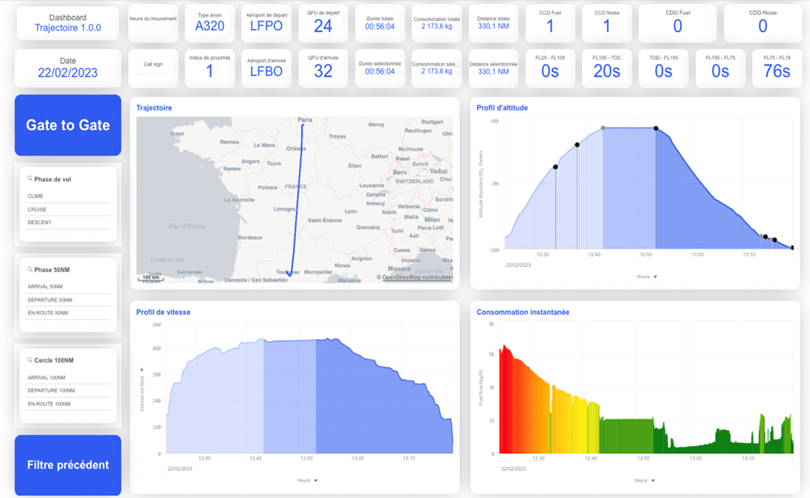
ACROPOLE Dashboard – Overview page
Developing a machine learning model for environmental purposes creates future opportunities. Specifically, it enables the direct calculation of fuel consumption from ADS-B/radar data, eliminating the need for pre-processing. Additionally, it lays the groundwork for defining aggregated indicators based on fuel consumption calculations, which can highlight various sources of inefficiency, such as changes in altitude, speed, level-off time, or weather conditions.
Provider
DSNA uses, for its own needs, ACROPOLE to assess the environmental impact (fuel consumption and CO2 emissions) and to analyse the 3D inefficiencies of aircraft operations with an ANSP point of view. “Data Office” of DSNA provides software maintenance of the existing model in a Big Data environment.
In parallel, EUROCONTROL is pursuing research into improving the model along various lines of analysis (see below “ACROPOLE Future Developments”).
DSNA is interested in future EUROCONTROL developments of the model. Contacts between EUROCONTROL and DSNA should be initiated shortly to consider the use of new versions of ACROPOLE model for DSNA purposes.
Versions and OS Requirements
ACROPOLE adds value to radar tracks by enhancing them with fuel flow & fuel burn. If using a Big Data environment instead of a local computer, the volume of data that can be handled and the calculation speed are considerably increased.
Data Requirements
Input data of the ACROPOLE model include:
- Parameters provided by radar data: aircraft type, altitude, ground speed, vertical speed (and derivatives of ground speed). If available, TAS can be used to predict consumption with greater accuracy.
- Parameters associated with aircraft characteristics: mass normalised by empty weight and maximum take-off weight, aircraft maximum operating speed, wing surface, etc.
Fuel flow coefficients at different characteristic thrust power (take-off, climb-out, approach, idle) are provided for each engine type using the ICAO aircraft engine emissions databank.
Limitations
The method employed consists in creating a fuel flow prediction model for “proxy aircraft” (A320, A332, B738, CRJX, CRJ7, E170, E190, ATR72), for which on-board data is available. These models offer good predictive accuracy but require long processing time to be trained.
Thanks to the scaling capabilities of the ACROPOLE model, a proxy aircraft (for example A320) is used to predict fuel flow of another aircraft (for example A319) when they have similar flight characteristics. A ratio of fuel flow coefficients between the two aircraft at different thrust power is used to scale the fuel flow of “non-proxy” aircraft in each flight phase. This process slightly affects the accuracy of the “non-proxy” aircraft consumption calculation.
Future Developments
The improvement targets of ACROPOLE are the subject of studies and research conducted by EUROCONTROL, including:
- Exploring approach of a unified model, usable for a variety of aircraft, by integrating specific parameters and features of aircraft types.
- Finding solutions to compensate for the unavailability of critical parameters such as TAS (True Airspeed) and mass.