

Overview
The Aviation Environmental Design Tool (AEDT) is a complex tool that models aircraft performance in a 4D environment to provide the following results:
- Fuel consumption.
- Emissions.
- Noise.
Note: the information provided in this section has been developed by the members of the group without validation by the AEDT providers.
All are highly interdependent and occur simultaneously throughout all phases of flight. AEDT was identified as a tool officially accepted by ICAO.
AEDT is developed by the U.S DOT Volpe Centre and is considered a next generation aviation environmental design tool that:
- Models aircraft performance in space and time (4D).
- Calculates noise, emissions, emissions dispersion and fuel consumption.
- Supports analyses of interdependencies between environmental consequences.
It allows conducting scalable studies from single airport to regional analysis to global analysis and is used for regulatory compliance, research and development.
Concerning system requirements, AEDT is a stand-alone Windows based application working under Windows 10. The tool requires to have a separate BADA licence. AEDT requires a modern dual core processor with 2 GHz or higher and a hard disk space of at least 100 GB with 16 GB for noise studies and 4 TB when doing emission calculations.
AEDT includes information about airports and air fleet that is permanently updated. Radar data can be used but must be transferred to the tool. It is possible to do modelling for simulations in a similar way to what is done in NEST in case of airspace design or new procedures.
Internal data in AEDT includes a database of 3.000 airframe-engine combinations and over 30.000 airports around the globe. The fleet database contains approximatively 4.600 aircraft (airframe/engine combinations) and 400 non-aircraft emissions sources (ground support equipment, stationary power and fuel equipment, and auxiliary power units).
It utilises the following databases:
- ICAO Aircraft Noise and Performance Database (ANP).
- BADA 3 and 4 (Eurocontrol Base of Aircraft Data).
- ICAO Engine Emission Databank (EDB).
Aircraft performance is the primary input to noise and emissions calculations. AEDT uses the following performance models to approximate the state of an aircraft for each aircraft operation:
- SAE-AIR-1845/ECAC Doc 29 performance model, used for modelling the terminal area (below 10,000 ft AGL).
- BADA 3 performance model, used for modelling the enroute phase (above 10,000 ft AGL).
- BADA 4 performance model, used for all flight regions, including terminal and enroute regions. Since BADA 4 does not contain data and methods to model aircraft operations on the ground, AEDT uses ANP methodology for the ground roll, take-off, initial climb and landing.
Concerning external data, those are mainly U.S. ones. For terrain and population, it is required to insert data relevant to the area that is being studied.
The inputs in AEDT are aircraft types and operations. They can be complemented with topography, weather and population (density). Input files are either csv or ASIF files.
The outputs are as follows:
- Flight performance reports (vertical profile).
- Emission and fuel reports, provided as numbers (no graphical view).
- Noise exposure reports, also provided as numbers.
- Noise contours and emission dispersion reports, which is the most valuable part to support studies.
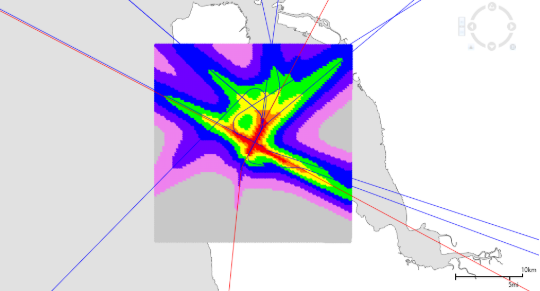
AEDT – Sample noise exposure contour (U.S. DOT Volpe Center/FAA graphic)
Provider
AEDT provider is the FAA's Office of Environment and Energy
Versions and OS Requirements
The latest version is AEDT 3g which was released on August 28, 2024.
AEDT is a stand-alone Windows based application. However, using Microsoft SQL Server connectivity, it is possible to connect multiple computational clients to one central database server.
AEDT uses the following databases/information:
- ICAO ANP Database.
- BADA 3 and 4.
- ICAO EDB.
Data Requirements
The following data is required for calculation:
- Airport code.
- Operation type – depending on the phase of flight (departure, climb, level, descent, approach).
- Aircraft type.
- Number of movements.
Limitations
The Population Exposure Report only works with the US Census data. For international users, one possible option is to generate and export noise contours from AEDT as a shapefile, then overlay that against population data in a separate GIS tool. Another option is to use the population point receptors in AEDT.
Future Developments
There is currently no information available about future developments.