

Overview
ENAIRE implemented the Malaga Improved Design of AirSpac project (MIDAS) that aims at measuring the efficiency of implemented procedures at Malaga airport (LEMG). This was done as part of a project for the transition from conventional to PBN approach according to the EU regulation.
It was based on common path having in mind the need to change runway configuration, increasing resilience to adverse weather events and improving the mode of ATC operations.
New ATC operational modes were implemented for arrival sequence, increasing predictability and reducing communication and frequency congestion (radio calls go from 3 to 1). It would also allow shorter departure procedures segregated from take-offs, increasing efficiency.
The procedure was implemented in November 2023 with an operational transition period of one month. After one year of assessing the results, the official Environmental monitoring started in December 2024 having in mind that the reporting is mandatory by law at Malaga and must be reported three years in the row.
The figure below presents the tracks for the North configuration arrivals with the difference between the “old” way of vectoring up to 2023 and the “new” one via PBN in 2024, aiming at reducing the miles flown and the amount of holding. It is to note that 2024 traffic considered for the monitoring of the implementation was 35% higher than 2023 traffic (21.518 versus 15.903).
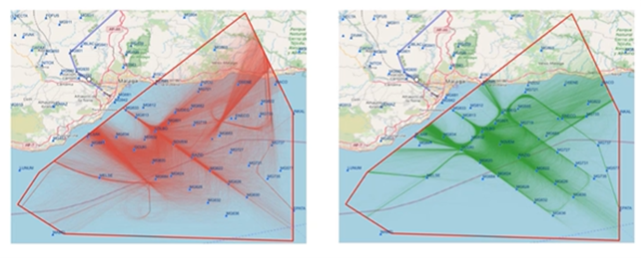
North configuration arrivals: 2023 (left) versus 2024 (right)
Before MIDAS, the average length of the approach path was around 35NM with 50% of the aircraft flying less than 32NM. After MIDAS, it was respectively 32NM and 30NM, meaning that it successfully met the objective.
The project also allowed to assess the “Probability of Flying “[x]” NM” in the approach before landing. As visible in the graph below, the probability to fly less than 20NM is much higher than before MIDAS, while the probability to fly more than 30 NM decreases. This demonstrates the efficiency of the new procedure.
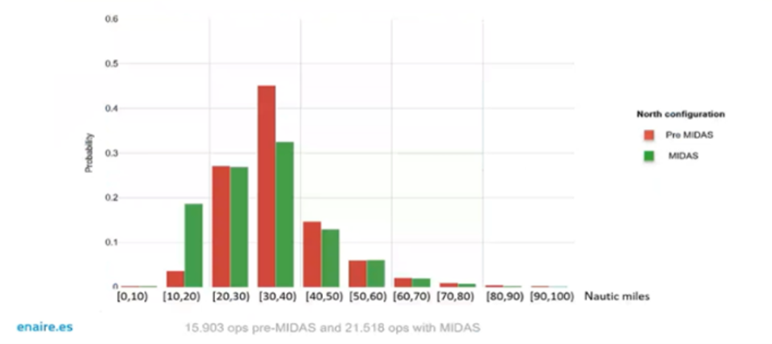
North configuration arrivals probability of flying [x]NM-2023 versus 2024 (2023 in red and 2024 in green)
As part of the next step for the North configuration, the idea is to publish the probability to fly a certain distance before landing depending on the time of the year and the day.
The figure below presents graphical results for the South configuration showing that traffic can merge at the same point when traffic is not too high.
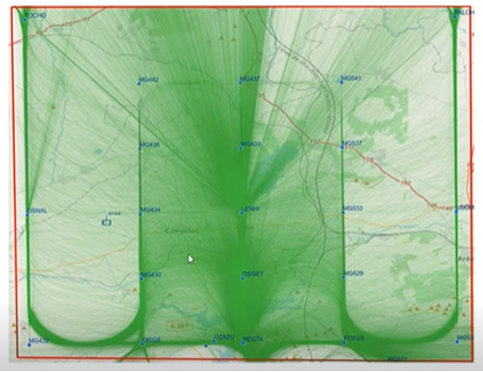
South configuration – Merging of traffic
The table below shows the differences in fuel consumption (in tons) and CO2 emissions (in tons as well) based on the requirements set by the Spanish authorities. It presents the different procedural elements addressed by the change (SID, STAR + approach and Total), both pre- and post-MIDAS implementation. The table considers the number of holdings (to estimate the fuel consumption) and the number of nautical miles flown, then compares the actual values with the estimated ones. Based on the estimation, a reduction of 0,16% in fuel consumption and CO2 emissions was reported.
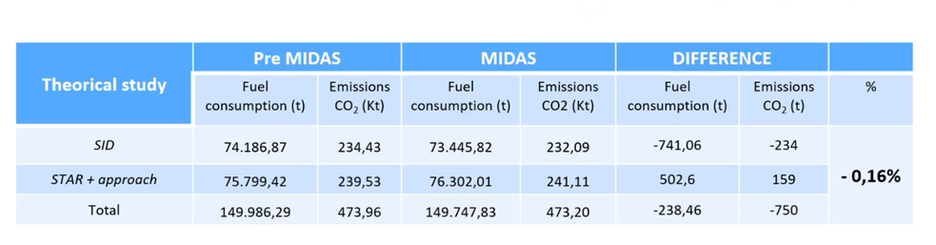
Table of assessment before and after the implementation of MIDAS
As a final step, the monitoring includes an analysis of the data together with ATC staff to identify best practices (not detailed here).