

Overview
Conventional aircraft noise assessments are typically based on residential population distribution and assume that people remain at their homes throughout the day. In reality, people move between home, work, education and leisure activities, which may significantly influence actual exposure to aircraft noise. This use case presents the Dynamic Noise Map (DNM) concept, developed and demonstrated using Heathrow Airport, which combines aircraft noise modelling with population mobility data to provide a more realistic assessment of community noise exposure.
Operational Context
Heathrow Airport is one of Europe’s busiest airports and is surrounded by densely populated urban areas. Understanding the true impact of aircraft noise on local communities is an important component of environmental management and stakeholder engagement.
Solution
The methodology combined aircraft noise contours generated using ECAC Doc 29 methods with mobility data from the London Travel Demand Survey (LTDS). Instead of considering only residential locations, the model estimated where people actually spend their time throughout the day and assessed noise exposure accordingly.
This enabled the creation of Dynamic Noise Maps that better reflect real-world population behaviour.
Results
The analysis showed that incorporating population mobility can significantly change estimates of community exposure. The Dynamic Noise Map scenario estimated approximately 10.9% more highly annoyed people than the traditional approach, while sleep disturbance levels remained largely unchanged.
The results indicate that conventional noise assessments may not always fully represent actual exposure patterns.
Benefits
Dynamic Noise Maps provide a more realistic understanding of aircraft noise impacts and can support environmental policy, community engagement and noise mitigation strategies. The methodology also offers opportunities for improved decision-making related to flight procedures and traffic management.
Transferability
The concept can be applied at other airports where suitable mobility and demographic datasets are available. It is particularly relevant for airports, ANSPs and regulators seeking to improve the accuracy of environmental assessments and stakeholder communication.
Links and References
Emir Ganić, Fiona Rajé, and Nico van Oosten. 2023. “New Perspectives on Spatial and Temporal Aspects of Aircraft Noise: Dynamic Noise Maps for Heathrow Airport.” Journal of Transport Geography 106 (January): 103527. https://doi.org/10.1016/j.jtrangeo.2022.103527.
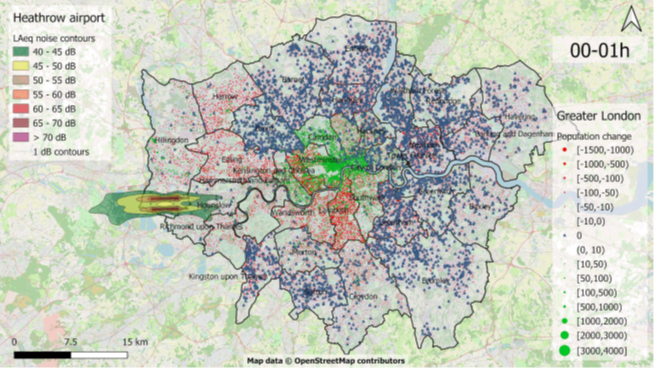
Noise Map