

Overview
The Landing and Take-Off (LTO) Cycle Emissions Estimator is designed to quickly and easily access emission information (CO2 and NOx emissions) during the landing and take-off phases of aircraft operations based on operational data instead of standardised ICAO LTO flight phase durations.
The information available in the LTO Dashboard is also available in FlyingGreen (see Section 3.5), however the LTO Dashboard provides more detailed historical emission overviews and functionalities in the LTO flight phases, close to operations at D+2.
The estimator includes the following key aspects:
- Phases covered: The LTO cycle encompasses the approach phase from 3000 feet to landing, taxi-in, taxi-out and take-off phase up to 3000 feet in the climb-out.
- The tool uses operational data of the taxi-in and taxi-out phases from EUROCONTROL’s Network Manager, including actual off-block times, take-off times and in-block times. This data replaces the standard taxi-in and taxi-out times defined by ICAO with more accurate, real-world values and improves the FEIS procedure.
- The tool provides a backward-looking analysis with data from the past five years, allowing airports to analyse historical emissions and identify areas for operational improvements.
- Users can customise the tool by selecting specific runways, flight phases, time slices, operators and wake categories. They can also adjust taxi times, introduce single-engine taxi operations and change the types of sustainable aviation fuels used.
- The tool includes a benchmarking feature that compares emissions and fuel burn across different airports in the same category, helping airports identify best practices and areas for improvement.
- The results and tables generated by the tool are exportable, allowing users to use the data for further analysis and reporting.
The estimator covers all the airports in the EUROCONTROL Area. The users can access their own data for their respective airport(s).
Network Manager’s flight data is used together with the Advanced Emission Model that considers specific aircraft/engine configurations, using the latest ICAO Aircraft Engine Emissions Databank. Airports integrated with the Network Manager (i.e., AOP/ NOP, A-CDM and Advanced ATC Tower airports) benefit from early availability of precise taxi time data per individual flight, thereby improving the accuracy of the estimates. If available, usually after several weeks, accurate taxi-time data input from airports or airlines will be used to update the initial operational data.
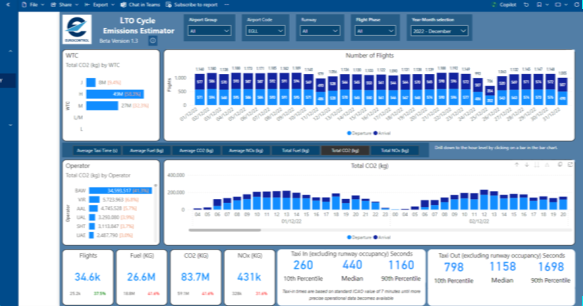
LTO Cycle Emissions Estimator overview (from webpage)
Provider
The dashboard was developed by EUROCONTROL to assist stakeholders in assessing the impact of flight operations on emissions and to support their reporting for both voluntary and legislative emissions reduction programmes.
This application was developed as part of the SESAR in-kind contributions to additional activities project RACINE within the SESAR 3 Research and Innovation Programme.
Limitations
The tool covers all the airports in the EUROCONTROL Area. The users can access their own data for their respective airport(s), which is updated daily and contains five years of historical data, but not older.
Future Developments
As part of the PEACOCK project the LTO Emission Estimator will include operational data for the airborne phases. In addition, some additional indicators may be added, such as holding time or level-off times.