

Overview
Pairwise separation is a solution that has been developed within the framework of the SESAR JU by NATS and other partners. It has been deployed at Heathrow Airport (EGLL) and at NATS’ Swanwick ATC Centre in December 2024, marking a world-first in Air Traffic Control.
This innovation is designed to boost on-time performance and reduce carbon emissions.
During approach and landing, aircraft need to be separated for wake turbulence reasons; this time is needed for the wake vortices to dissipate sufficiently. In most cases, ATC use (fixed) distances between consecutive arrivals to achieve this separation; the distance depends on the aircraft type of both the leading and following aircraft. Especially in (strong) headwind operations, using the same (fixed) distance substantially increases the time between two consecutive arrivals. As a result, the arrival rate drops and potentially impacts capacity.
To overcome this issue, Time-Based Separation (TBS) can be introduced. Instead of using (fixed) distances, it directly applies a time separation for wake turbulence purposes. The goal is to maintain a consistent time interval between arriving aircraft, even if the distance between them changes due to wind.
TBS is an enabler of Pairwise. It is beneficial at Heathrow due to the airports’ two runways being 99% capacity constrained. High winds (typically 65 days a year) at Heathrow cause significant ATFM delays, reducing landing rates from 40-45 to as low as 32 per hour in the case of strong headwinds. This situation increases holding delays hence increased fuel burn and emissions and may cause flight cancellation. TBS allows the management of separation between aircraft during landing, especially in varying wind conditions.
TBS is used to nominal separation: aircraft are typically separated by a set distance (e.g., 6 miles, 4 miles, 5 miles) based on their type. In strong headwinds, the time to cover these distances increases, leading to longer intervals between landings. TBS adjusts the separation distance based on wind conditions to maintain the same time interval. Stronger winds result in shorter distances between aircraft to keep the landing rate consistent. In the case of strong headwinds, with TBS, the distance between aircraft is reduced to maintain the same time interval, improving landing rates up to 40 aircraft per hour in strong headwinds (instead of about 35).
Another enabler has been the use of RECAT (Re-categorisation of Wake Turbulence Separation Minima) concept, that updates aircraft categories based on weight and wingspan, allowing for more efficient separations. RECAT EU divides aircraft into six categories (from A to F) based on wake turbulence. Enhanced TBS was implemented in 2018 when NATS moved to RECAT-EU. Along with this change, they introduced optimised runway delivery that provided ATCOs with indicator support until the leader gets the threshold. When the leader crosses 4 DME and starts to decelerate, compression starts with the aircraft behind because that one is still flying at 160 knots. Compression is entirely aircraft type or type variant dependent (because of standard speed on final).
The wake vortex categories have been further refined with RECAT EU Pairwise which provides specific separation distances for each aircraft pair, optimising safety and efficiency. This was implemented in the latest version of Intelligent Approach at Heathrow in December 2024 and is known as Pairwise. This allows individual wake separations for 40 most common aircraft types at Heathrow, meaning 1600 possible combinations, hence a need for support tools since an ATCO cannot cope with so many possibilities. It has been an incremental change over the years, evolving from indicator support (the deceleration point between wake aircraft) to indicated support between all aircraft pairs, including the compression support to thresholds.
Pairwise separation also factors in runway occupancy time, ensuring aircraft have enough time to land, decelerate and vacate the runway before the next aircraft lands. This helps maintain a smooth flow of arrivals and departures, reducing delays and improving efficiency
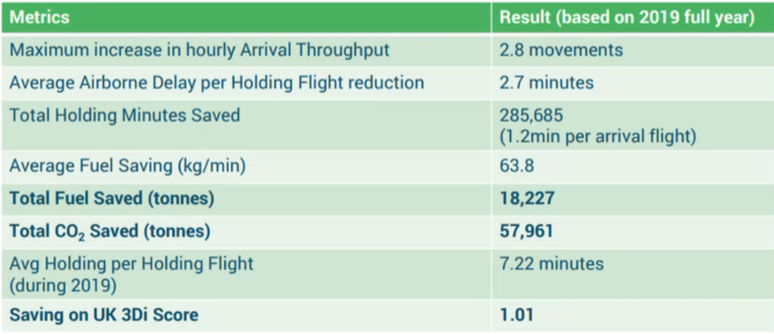
Table of predicted benefits of Pairwise (UK)
TBS has also been implemented at Amsterdam Schiphol (EHAM), where environmental benefits have been confirmed in terms of noise because of its operational set-up with six runways, with two noise preferential landing runways and where they open the other runways when they have increased demand. Amsterdam can land on average between three and six additional aircraft per hour per noise preferential landing runway. This means they are opening their non-noise preferential runways less often, providing also a benefit in terms of noise reduction thanks to TBS.
The tool has also been implemented in Toronto Pearson (CYYZ).