

Overview
Accurate estimation of aircraft emissions at airport level is essential for environmental reporting and the evaluation of operational improvement measures. Traditional emission inventories are typically based on the ICAO Landing and Take-Off (LTO) methodology, which uses standard assumptions for aircraft operating times during taxiing and other flight phases. These assumptions may not always reflect local airport conditions and can therefore affect the accuracy of calculated emissions.
This use case presents a simulation-based approach developed for Airport Podgorica (LYPG) to estimate aircraft fuel consumption and emissions using airport-specific operational data.
Operational Context
Airport Podgorica is Montenegro’s main international airport, operating a single runway and handling approximately 7,500 aircraft movements per year. Due to relatively short taxi distances and low operational complexity, local operating conditions differ significantly from the assumptions used in standard emissions methodologies.
Solution
A discrete-event simulation model was developed using MATLAB Simulink and SimEvents. The airport surface was modelled as a network of runways, taxiways, intersections and parking stands. The model simulated aircraft arrivals, departures, taxi movements, runway occupancy and queue formation under realistic operating conditions.
Fuel consumption and emissions were calculated for individual aircraft types and compared with results generated using EUROCONTROL’s IMPACT tool.
Results
The simulation estimated average taxi-in and taxi-out times of approximately 60 and 190 seconds respectively, significantly lower than standard ICAO assumptions. Comparison with IMPACT showed good agreement for fuel burn and CO₂ emissions calculations.
The study demonstrated that the use of generic taxi-time assumptions can substantially overestimate airport emissions, particularly carbon monoxide (CO) and hydrocarbon (HC) emissions.
Benefits
The approach provides airports and ANSPs with a more realistic method for estimating aircraft emissions and assessing the environmental impact of airport operations. It can support environmental reporting, sustainability programmes and the evaluation of operational improvements.
Transferability
The methodology can be applied at other airports where local operational characteristics differ from standard assumptions and where more accurate emissions assessments are required.
Links and References
Nikola Lukačević, Bojana Mirković, Marko Đogatović, and Emir Ganić. 2022. “Simulation Model for Estimation of Aircraft Emissions at Airport Podgorica.” Transportation Research Procedia 65: 180–89. https://doi.org/10.1016/j.trpro.2022.11.021.
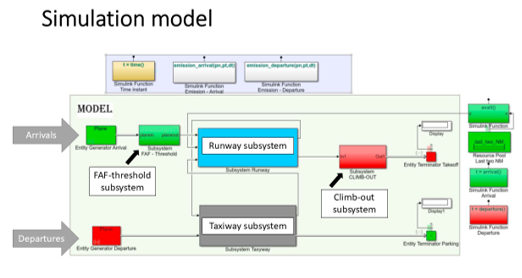
Simulation Model
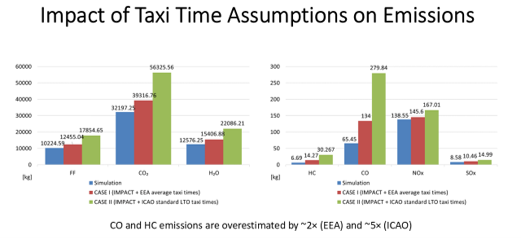
Impact of Taxi Time Assumptions on Emissions